dimanche 29 janvier 2023

H.G. Wells and Human Rights


by Rene Wadlow
2023-01-27 08:59:32


2023 will see a year-long effort leading to 10 December 2023, the 75th anniversary of the Universal Declaration of Human Rights.  The effort carries the title "Dignity, Freedom and Justice for All".  Thus, it is useful to look at some of the intellectual preparations both within the League of Nations and among individual thinkers for the Universal Declaration.  One of the most widely read was that of Herbert George Wells "Declaration of the Rights and Duties of the World Citizen" which is found in his book "Phoenix: A Summary of the Inescapable Conditions of World Organization" published in 1942.  The Declaration of the Rights and Duties of the World Citizen had been translated into 10 languages and sent to 300 editors of newspapers in 48 countries.

H.G. Wells from the 1930s on was concerned with the ways the world should be organized with a world organization stronger than the League of Nations.  Such a world organization should be backed up and urged on by a strong body of public opinion linked together world-wide by the unifying bond of a common code of human rights and duties.

At the end of the First World War, H.G. Wells was a strong advocate of the League of Nations, but as time went on, he became aware of its weaknesses.  He wrote in 1939 " The League of Nations, we can all admit now, was a poor and ineffective outcome of that revolutionary proposal to banish armed conflict from the world and inaugurate a new life for mankind... Does this League of Nations contain within it the gem of any permanent federation of human effort?  Will it grow into something for which men will be ready to work for and, if necessary, fight - as hither to they have been willing to fight for their country and their own people?  There are few intimations of any such enthusiasm for the League at the present time.  The League does not even seem to know how to talk to the common man.  It has gone into official buildings, and comparatively few people in the world understand or care what it is doing there."

Thus, there was a need for a clear statement of world values that could be understood by most and that would be a common statement of the aspiration on which to build a new freedom and a new dignity.  Wells had a strong faith in international public opinion when it was not afraid to express new and radical thoughts that cut across the conventional wisdom of the day.  He wrote in 1943 "Behind the short-sighted governments that divide and mismanage human affairs, a real force for world unity and order exists and grows."

Wells hoped that the "Declaration of the Rights of the World Citizen" would become the fundamental law for mankind through the whole world - a true code of basic rights and duties which set out the acceptable shape of a just world society.

Wells set out 10 rights which combined civil liberties already common to many democratic states with economic and social rights which were often considered as aspirations but not as rights.  Thus among the 10 rights we find the Right to Participate in Government, Freedom of Thought and Worship, the Right to Knowledge, Freedom from Violence including Torture, along with the Right to Education, the Right to Medical Care, the Right to Work with Legitimate Remuneration, the Protection of Minors, Freedon of Movement about the Earth.

The drafters of the U.N. Charter in 1945 included a pledge by member states "to reaffirm faith in fundamental human rights, in the dignity and worth of the human person, in equal rights of men and women, and of nations large and small."  Much of the debate from 1946 when the U.N. Commission on Human Rights was created until December 1948 when the Universal Declaration of Human Rights was proclaimed concerned the relative place of civil liberties and of economic, social, and cultural rights.

While the text of H.G. Wells is largely forgotten today, he had the vision of the strong link between freedom of thought based on civil liberties and the need for economic dignity set out in the economic, social, and cultural rights.


Rene Wadlow, President, Association of World Citizens

jeudi 29 septembre 2022

Saber Rattling With Nuclear Weapons.


Rattling With Nuclear Weapons.

 September 25, 2022Rene Wadlow
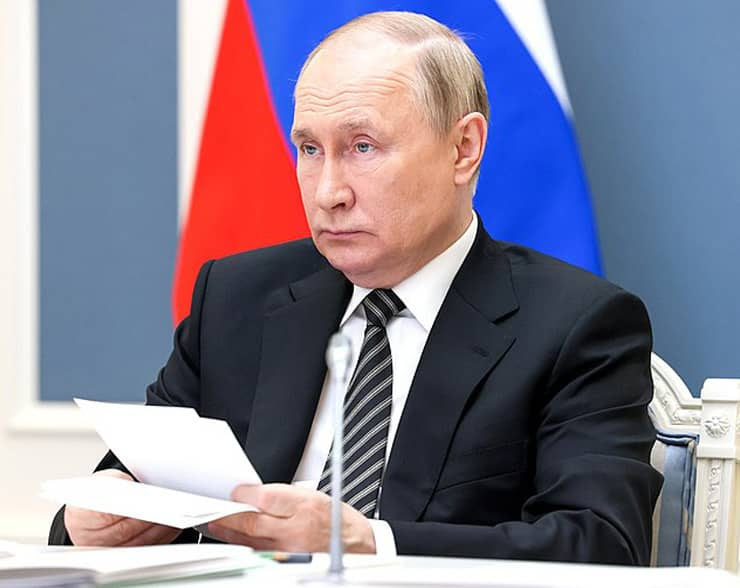
Featured Image: During the meeting of the Supreme Eurasian Economic Council (via videoconference). By Kremlin.ru, CC BY 4.0 <https://creativecommons.org/licenses/by/4.0>, via Wikimedia Commons.
On 21 September, the United Nations designated Day of PeaceVladimir Putin, President of the Russian Federation in an address to the nations said:

” I am addressing you – all citizens of our country, people of different generations, ages and ethnicities, the people of our great Motherland, all who are united by the great historical Russia, soldiers, officers and volunteers who are fighting on the frontline and doing their combat duty, our brothers and sisters in the Donetsk and Lugansk People’s Republics, Kherson and Zaporazhye regions and other areas that have been liberated from the neo-Nazi regime.” 

He set out the dangers facing the Federation.

“The goal of that part of the West is to weaken, divide and ultimately destroy our country.  They are saying openly now that in 1991 they managed to split up the Soviet Union and now is the time to do the same to Russia, which must be divided into numerous regions that would be at deadly feud with each other… Washington, London and Brussels are openly encouraging Kiev to move hostilities to our territory.  They openly say that Russia must be defeated on the battlefield by any means, and subsequently deprived of political, economic, cultural and any other sovereignty and ransacked.”

 
      To meet these challenges he ordered a:

” partial mobilisation in the Russian Federation to defend our Motherland and its sovereignty and territorial integrity, and to ensure the safety of our people and people in the liberated territories.”


Sergei Shoigu, the Russian Defense Minister, set out the details in a public statement just after Putin’s address.  The mobilization will call up men below the age of 65 who have had military service.  There are some 300,000 people in this category.
     The nuclear saber rattling followed.  Putin went on:

” I am referring to the statements made by some high-ranking representatives of the leading NATO countries on the possibility and admissibility of using weapons of mass destruction –  nuclear weapons against Russia… In the event of a threat to the territorial integrity of our country and to defend Russia and our peole, we will certinaly use all weapon systems available to us.  This is not a bluff.” 

He ended by saying:

“The citizens of Russia can rest assured that the territorial integrity of our Motherland, our independence and freedom will be defended – I repeat – by all the systems available to us.”


What makes the current situation more ambiguous and dangerous is that Vladimir Putin announced and confirmed by Sergei Shoigu that from 23 to 27 September 2022, there would be referendums in the Donetsk and Lugansk People’s Republics and in the areas under Russian control in the Kherson and Zaporazhye regions on joining the Russian Federation.
People who are refugees in Russia from these areas will also be able to vote. A vote favorable to joining Russia is not in doubt.  Thus any future military operations by Ukraine forces in these areas could be considered by Russia as an attack on Russian territory.
     It is impossible to know to what extent the nuclear weapon saber rattling is serious, if it goes beyond a justification for the mobilization of former military – not a popular policy.  The situation calls for active efforts to decrease tensions on the part of the U.N. of national governments and of NGOs.  The next weeks may be crucial.
 
  René Wadlow, President, Association of World Citizens.

President, Association of World Citizens (AWC).

dimanche 26 juin 2022

26 June: International Day Against Torture / journée internationale contre la torture

 26 June: International Day Against Torture.

by Rene Wadlow
2022-06-26 08:41:02


Torture has a bad name among the police and security agencies of most countries. Thus torture is usually called by other names.  Even violent husbands do not admit to torturing their wives.  Thus;  when NGO representatives started to raise the issue of torture in the UN Commission on Human Rights in Geneva in the early 1980s;  the government representatives replied that it was a very rare practice;  limited to a small number of countries and sometimes a “rogue” policeman or prison guard.
However;  NGO representatives insisted that, in fact, it was widely used by a large number of countries including those that had democratic forms of government. - Sean MacBride (1904-1988)

tort00001_400

Getting torture to be recognized as a real problem;  and then having the Commission on Human Rights create the post of Special Rapporeteur on Torture; owes much to the persistent efforts of Sean MacBride (1904-1988); at the time the former chairman of the Amnesty International Executive Committee (1961-1974) and a Nobel Peace Prize laureate (1974). MacBride had been the Foreign Minister of Ireland (1948-1951);  and knew how governments work.

However; He had earlier been a long-time leader of the Irish Republican Army (IRA); being the son of John MacBride; an executed leader of the 1916 Easter Rising – an attack on the Dublin Post Office. With his death John MacBride became an Irish hero of resistance.  Later Sean had spent time in prison accused of murder. He told me that he had never killed anyone;  but as the IRA Director of Intelligence he was held responsible for the murders carried out by men under his command.  Later, he also worked against the death penalty.

26 June as the International Day in Support of Victims of Torture.

As examples of the current use of torture kept being presented by NGO representatives and as some victims of torture came to Geneva to testify; the Commission on Human Rights named a Special Rapporteur and also started to work on what became the Convention against Torture and Other Cruel; Inhuman or Degrading Treatment or Punishment. The Treaty came into effect on 26 June 1987 and in1997 the UN General Assembly designated 26 June as the International Day in Support of Victims of Torture.

Independent Experts.

Human Rights treaties negotiated within the UN create what are known as “Treaty Bodies” ­ a group of persons who are considered to be “independent experts”. As the saying around Geneva goes; “some are more ‘expert’ than others, and some are more ‘independent’ than others.  Countries which have ratified a human rights convention should make a report every four or five years to the specific Treaty Body. For the Torture Treaty;  it is every four years to the 10-person expert group.

Many States are late, some very late, in meeting this obligation. There are 158 States which have ratified the Torture Convention;  but some 28 States have never bothered to file a report. States which have not ratified the treaty do not make reports.

Concluding Observations.

NGO representatives provide the experts with information in advance and suggest questions that could usefully be asked. The State usually sends representatives to Geneva for the Treaty Body discussions as the permanent Ambassador  is rarely able to answer specific questions on police and prison conditions. At the end of the discussion between the representative of a State and the experts; the experts write “concluding observations” and make recommendations.

Unfortunately; the Convention is binding only on States.  However; increasingly non-governmental armed militias;  such as ISIS in Syria and Iraq carry out torture in a systematic way. The militia’s actions can be mentioned but not examined by the Treaty Body.

While there is no sure approach to limiting the use of torture; much depends on the observations and actions of non-governmental organizations.  We need to increase our efforts; to strengthen the values which  prohibit torture, and watch closely how persons are treated by the police, prison guards and armed militias.

 ***************************

Rene Wadlow, President and a Representative to the United Nations, Geneva, of the Association of World Citizens.

dimanche 5 septembre 2021

Menace sur les minorités d'Afghanistan


By René Wadlow

The Association of World Citizens (AWC) is strongly concerned by possible repression against the Hazara population in Afghanistan, repression of such an extent that it could be considered genocide. While it is still too early to know what the policies and practice of the Taliban toward minorities will be now, during the past Taliban rule (1996-2001) there was systematic discrimination against the Hazara and a number of massacres.


There are some three million Hazara whose home area is in the central mountainous core of Afghanistan, but a good number have migrated to Kabul, most holding unskilled labor positions in the city. The Hazara are largely Shi’a in religion but are considered as non-Muslim heretics or infidels by the Taliban as well as by members of the Islamic State in Khorasan (ISIS-K), now also an armed presence in Afghanistan.

In the past there was a genocidal period under the rule of Abdur Rahman Khan. During the 1891-1893 period, it is estimated that 60 percent of the Hazara were killed, and many others put into slavery-like conditions.

To understand fully the concern of the AWC for the Hazara, it is useful to recall Article II of the 1948 Convention against Genocide.


In the present Convention, genocide means any of the following acts committed with intent to destroy, in whole or in part, a national, ethnic, racial or religious group, as such:


* Killing members of the group;
* Causing serious bodily or mental harm to members of the group;
* Deliberately inflicting on the group conditions of life calculated to bring about the physical destruction in whole or in part;
* Imposing measures intended to prevent births within the group;
* Forcibly transferring children of the group to another group.


There have been repeated appeals to make the 1948 Genocide Convention operative as world law. The then United Nations Secretary-General, Kofi Annan, said in an address at UNESCO on December 8, 1998 “Many thought, no doubt, that the horrors of the Second World War – the camps, the cruelty, the exterminations, the Holocaust – could not happen again. And yet they have. In Cambodia, in Bosnia and Herzegovina, In Rwanda. Our time – this decade even – has shown us that man’s capacity for evil knows no limits. Genocide – the destruction of an entire people on the basis of ethnic or national origins – is now a word our out time too, a stark and haunting reminder of why our vigilance but be eternal.”

The 1948 Convention has an action article, Article VIII:


Any Contracting Party may call upon the competent organs of the United Nations to take such action under the Charter of the United Nations as they consider appropriate for the prevention and suppression of acts of genocide […]

Despite factual evidence of mass killings, some with the intent to destroy “in whole or in part”, no Contracting Party has ever called for any action under Article VIII. (1)

The criteria for mass killings to be considered genocide does not depend on the number of people killed or the percentage of the group destroyed but on the possibility of the destruction of the identity of a group. It is the identity of the Hazara and their religious base which is the key issue. Events need to be watched closely, and nongovernmental organizations must be prepared to take appropriate action.

Note
(1) For a detailed study of the 1948 Convention and subsequent normative development see: William A. Schabas, Genocide in International Law (Cambridge University Press, 2000, 624 pp.)

Prof. René Wadlow is President of the Association of World Citizens.

jeudi 26 août 2021

Simone Weil

Simone Weil, who died on 24 August 1943, was one of those warning voices writing a memo inLondon for General Charles DeGaulle’s Free French on the problems that would face France after the victory over Nazi occupation. Her memo concerning the need for humanity, non-violence, and equity was published after the War as Enracinement in French and The Need for Roots in English. The memo, too philosophical for people who were primarily concerned with the upcoming D-Day and the need to coordinate the different resistance movements within France, had little impact.

“In the day of Victory, the angel of justice strives with the demons of violence; the heart of the victor all too easily is hardened; moderation and far-seeing wisdom appear to him weakness; the excited passion of the people, often inflamed by the sacrifices and suffering they have borne, obscure the vision even of responsible persons and make them inattentive to the warning voices of humanity and equity.” - J. Naughton


No one in the Free French leadership was sure where Simone Weil fit into the different groups which had assembled in London. The Free French officials had quickly rejected her request to be sent back to France to partake in armed resistance or in helping the wounded. Simone Weil had had a short experience with armed combat as part of an anarchist brigade in Spain in the Civil War against Franco, but her poor eyesight and very fragile health had quickly put an end to her armed participation. She returned from Spain convinced of the need for non-violent action, influenced by her philosophical interest in Indian thought and the efforts of Mahatma Gandhi. She also returned from Spain as a convinced opponent of the death penalty having tried to stop her anarchist co-fighters from executing prisoners of war and Catholic priests. Her non-violence is expressed in a powerful prose-poem ‘L’Iliade: A Poem of Force, published in both French and English, first under her pen name, Emile Novis

She had begun her intellectual life as a Marxist but an anti-Stalinist one. As a young philosophy teacher, she had housed Leon Trotsky in her Paris apartment, but found Trotsky dogmatic and too willing to justify the policies of the Soviet Union even as he opposed Stalin. Simone Weil’s Marxism was embodied in no political formation and was more an ideal form based on compassion for the fate of workers than from an expression of class struggle. Simone Weil was above all indebted to the writings of Plato and her teaching was largely related to Plato and classical Greek thought. The cave from where one only sees shadows is her image of the world in which we live.

She was interested in the spiritual dimensions of religion without ever becoming a member of an organized religion. She came from an agnostic Jewish background. Her brother, André Weil who was able to leave France for the USA in 1941 was a well-known mathematician whose career was largely spent at the Institute for Advanced Studies at Princeton, New Jersey. The Institute had been created to house Albert Einstein and was home for a good number of theoretical mathematicians.

Simone Weil was interested in Taoism, Hinduism and in the person of Jesus. As she wrote, Osiris in Egypt and the Krishna of the Gita were also incarnations of the Divine. Her views of Jesus as Prince of Peace kept her outside the Catholic Church, but after her return from Spain, she started meeting with Catholic intellectuals.

The most significant of these was Gustave Thibon (1903-2001) who lived not far from where I live in Ardeche, south-central France, but I never met him. Simone Weil and her family had been able to leave Paris in 1940 for Marseille in what was then still “Unoccupied France” under the French government of Vichy. Simone Weil’s parents and brother left for the safety of the USA, but she refused to leave those suffering behind. Thus, through mutual friends in Catholic intellectual circles, she went to live in Ardeche, helped by Gustave Thibon. She left all her writings, nearly all unpublished, with Thibon when she left Ardeche to join the Free French in London. Thibon oversaw the publication of her writings and wrote perceptive introductions to many of them after her death.

Gustave Thibon was a self-taught philosopher and poet but also a wine producer, wine being the economic base of our area. Thibon had left school at 16 at the death in the First World War of his father in order to help his grandfather tend the wine vines. Thibon remained a farmer all his life, even after the Second World War when his philosophical writings became well known, and he was often asked to give talks in different European countries. Thibon understood the driving energy of Simone Weil, her constant questioning of ideas and her desire to put her ideals into practice. Thibon was part of a network of intellectual Catholics who were also concerned with the future of France after the war. Along with Thibon, the group included Louis-Joseph Lebret, a Catholic priest who played a large role in creating the cooperative movement in France and who helped draw up the first development plans for Senegal after its independence in 1960. Francois Perroux whose economic ideas set the stage for the first post-war reconstruction and planning in France was also a member of the network.

Although Thibon and the others were orthodox Roman Catholics, they were united with Simone Weil in trying to build a synthesis between philosophical thought and economic conditions, especially of the poorest and those ground down by repetitious factory work.

Simone Weil’s health, always poor, declined in London, and she died at age 34. It is only after her death that her writings in notebooks were structured into books. Her life and writings are a prime example of the effort to establish a link between society and the direction of thought.


************************************************************


Rene Wadlow, President, Association of World Citizens

Association Médicale Mondiale (AMM)

L'Association Médicale Mondiale (AMM) est une organisation internationale de médecins. Elle a été fondée le 17 septembre 1947, alors que des médecins de quelque 27 pays se réunissaient en première assemblée générale à Paris. Elle est financée par les contributions annuelles de ses membres dont le nombre s'élève aujourd'hui à 106. L'AMM constitue pour ses associations membres un forum de libre communication et de coopération active dont le but est de parvenir à un consensus sur les plus hautes normes d'éthique médicale et de compétence professionnelle et de promouvoir l'indépendance professionnelle des médecins."


Adoptée par la 2e Assemblée Générale, Genève, Suisse, Septembre 1948,
révisée par la 22e Assemblée Médicale Mondiale, Sydney, Australie, Août 1968,
la 35e Assemblée Médicale Mondiale, Venise, Italie, Octobre 1983,
la 46e Assemblée générale, Stockholm, Suède, Septembre 1994,
la 170e Session du Conseil, Divonne-les-Bains, France, Mai 2005,
la 173e Session du Conseil, Divonne-les-Bains, France, Mai 2006,
la 68e Assemblée générale, Chicago, Etats-Unis, Octobre 2017,
et (dans sa version française uniquement) par la 71e Assemblée générale de l’AMM (en ligne), Cordoue, Espagne, octobre 2020


Le Serment du médecin

EN QUALITÉ DE MEMBRE DE LA PROFESSION MÉDICALE

JE PRENDS L’ENGAGEMENT SOLENNEL de consacrer ma vie au service de l’humanité ;

JE CONSIDÉRERAI la santé et le bien-être de mon patient comme ma priorité ;

JE RESPECTERAI l’autonomie et la dignité de mon patient ;

JE VEILLERAI au plus grand respect de la vie humaine ;

JE NE PERMETTRAI PAS que des considérations d’âge, de maladie ou d’infirmité, de croyance, d’origine ethnique, de genre, de nationalité, d’affiliation politique, de race, d’orientation sexuelle, de statut social ou tout autre facteur s’interposent entre mon devoir et mon patient ;

JE RESPECTERAI les secrets qui me seront confiés, même après la mort de mon patient ;

J’EXERCERAI ma profession avec conscience et dignité, dans le respect des bonnes pratiques médicales ;

JE PERPÉTUERAI l’honneur et les nobles traditions de la profession médicale ;

JE TÉMOIGNERAI à mes professeurs, à mes collègues et à mes étudiants le respect et la reconnaissance qui leur sont dus ;

JE PARTAGERAI mes connaissances médicales au bénéfice du patient et pour les progrès des soins de santé ;

JE VEILLERAI à ma propre santé, à mon bien-être et au maintien de ma formation afin de prodiguer des soins irréprochables ;

JE N’UTILISERAI PAS mes connaissances médicales pour enfreindre les droits humains et les libertés civiques, même sous la contrainte  ;

JE FAIS CES PROMESSES sur mon honneur, solennellement, librement.

dimanche 22 août 2021

World Humanitarian Day: A Need for Common Actions


The United Nations General Assembly has designated 19 August as “World Humanitarian Day” to pay tribute to aid workers in humanitarian service in difficult and often dangerous conditions. 19 August was designated in memory of the 19 August 2003 bombing of the UN office building in Baghdad, Iraq in which Sergio Vieira de Mello, UN High Commissioner for Human Rights and at the time Special Representative of the UN Secretary General was killed along with 21 UN staff members. Over 200 UN employees were injured. The exact circumstances of the attack are not known, and why USA and UN security around the building was not tighter is still not clear. A truck with explosives was able to dive next to the building and then blew itself up.

Sergio de Mellow had spent his UN career in humanitarian efforts, often with the Office of the High Commissioner for Refugees and at other times as Special Representative of the UN Secretary General. As an NGO representative to the UN in Geneva and active on human rights issues, I knew him during his short 2002-2003 tenure as High Commissioner for Human Rights. Many of us had high hopes that his dynamism, relative youth (he was 54) and wide experience in conflict resolution efforts would provide new possibilities for human rights efforts. His death along with the death of others who had been Geneva-based was a stark reminder of the risks that exist for all engaged in humanitarian and conflict resolution work.

This year the risks and dangers are not just memories but are daily news. On 3 May 2016, the UN Security Council unanimously adopted Resolution 2286 calling for greater protection for health care institutions and personnel in light of recent attacks against hospitals and clinics in Syria, Iraq, Yemen, South Sudan, Democratic Republic of Congo, and Afghanistan. These attacks on medical facilities are too frequent to be considered “collateral damage.” The attacks indicate a dangerous trend of non-compliance with world law by both State and non- State agents. The protection of medical personnel and the treatment of all the wounded − both allies and enemies − goes back to the start of humanitarian law.

wc00


The Association of World Citizens has stressed the need for accountability, including by investigation of alleged violations of the laws of war. The grave violations by the Islamic State (ISIS) must be protested by as wide a coalition of concerned voices as possible. There is a real danger that as ISIS disintegrates and no longer controls as much territory, it will increase terrorist actions.

The laws of war, now more often called humanitarian law, have two wings, one dealing with the treatment of medical personnel in armed conflict situations, the military wounded, prisoners of war, and the protection of civilians. This wing is represented by the Geneva (Red Cross) Conventions. The second wing, often called The Hague Conventions limit or ban outright the use of certain categories of weapons. These efforts began at The Hague with the 1900 peace conferences and have continued even if the more recent limitations on land mines, cluster weapons and chemical weapons have been negotiated elsewhere.

human02_400


The ban on the use of weapons are binding only on States which have ratified the convention. Thus the current use of USA-made cluster weapons in Yemen by the Saudi Arabia-led coalition is, in a narrow sense, legal as the USA, Saudi Arabia and Yemen have not signed the cluster weapon ban. The Association of World Citizens was one of the NGOs leading the campaign against cluster weapons. My position is that when a large number of States ratify a convention (which is the case for the cluster-weapons ban) then the convention becomes world law and so must be followed by all States and non-State actors even if they have not signed or ratified the convention. The same holds true for the use of land mines currently being widely used by ISIS in Syria and Iraq.

The current situation concerning refugees and internally-displaced persons can also be considered as part of humanitarian law. Thus those working with refugees and the displaced within their country are also to be honored by the World Humanitarian Day. To prevent and alleviate human suffering, to protect life and health and to ensure respect for the human person − these are the core values of humanitarian law.

There needs to be a wide public outcry in the defense of humanitarian law so that violations can be reduced. The time for action is now.

 ************************************************

Rene Wadlow, President, Association of World Citizens